
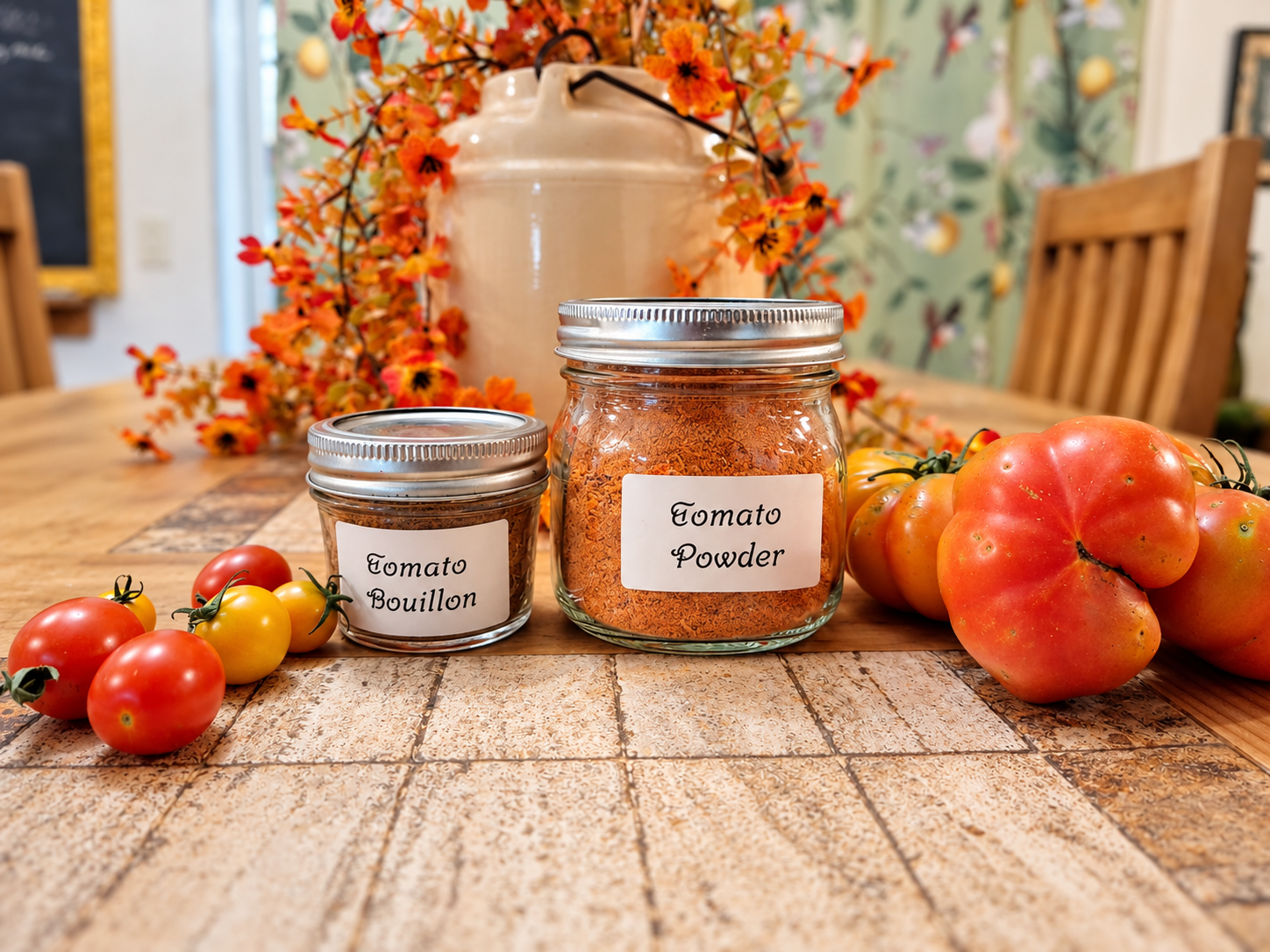
From garden-fresh tomatoes to two flavorful pantry staples! Homemade tomato powder and vegetarian tomato bouillon are easy to make, take up very little space, and add rich tomato flavor to everyday cooking.
Preserve your garden tomatoes without canning or freezing—and turn them into two incredibly useful pantry staples.
Some links in this post may be affiliate links. As an Amazon Associate, I earn from qualifying purchases at no additional cost to you.
What if you could take a whole bunch of garden tomatoes and turn them into a little jar of powder that takes up almost no space in your pantry?
That’s exactly what I’ve been doing with some of our late-season tomatoes here at Mutiny Ranch, and it’s quickly becoming one of my favorite ways to preserve the harvest.
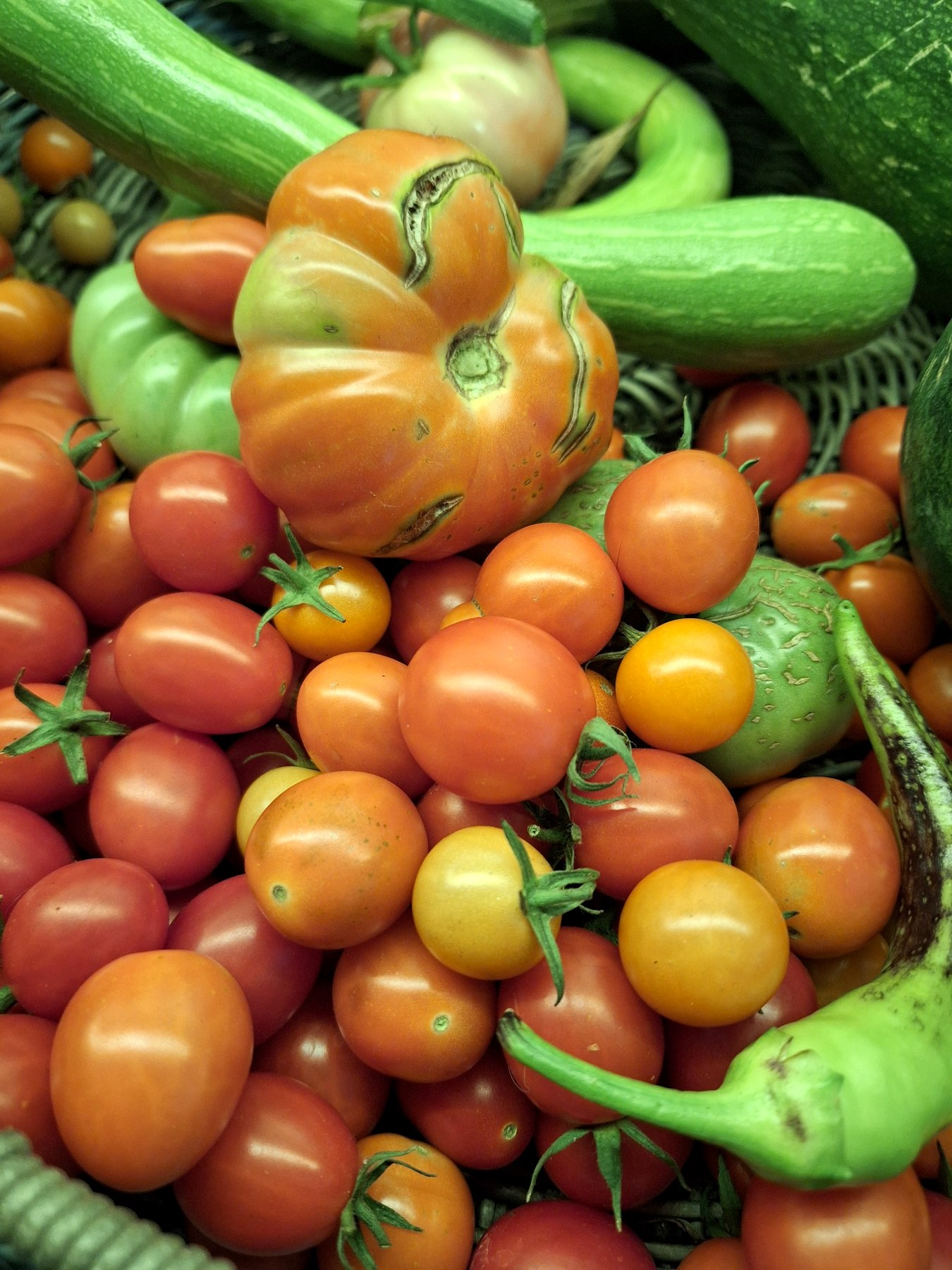
The late-season garden harvest at Mutiny Ranch! A colorful mix of Sun Gold cherry tomatoes, Italian storage tomatoes, and larger heirlooms—all perfect for turning into homemade tomato powder.
I’d already put up quite a few tomatoes this year, but the Sun Gold cherry tomatoes and Italian winter storage tomatoes just kept coming. My freezer was getting crowded, and I really didn’t want to find room for another bag of tomatoes.
So I decided to make tomato powder.
Not only does it take up very little space, but it’s incredibly versatile. I can add it directly to soups, chili, and rice dishes, or mix it with water to make tomato paste or tomato sauce.
And this year, I took things one step further and used some of that powder to make homemade vegetarian tomato bouillon.
That turned out to be an especially good experiment!
Watch: How I Make Tomato Powder and Bouillon
Here’s the complete process, from slicing fresh garden tomatoes to making tomato powder and seasoning it into homemade bouillon.
Why Make Tomato Powder?
There are plenty of good ways to preserve tomatoes. I’ve canned, frozen, and roasted them over the years, and each method has its place.
But tomato powder has some advantages that make it especially useful in my kitchen.
It saves an incredible amount of space. A large quantity of fresh tomatoes can be reduced to a surprisingly small jar once they’re thoroughly dried and ground.
It’s convenient. There’s no thawing, and I don’t have to open a can when I only need a little tomato flavor.
It helps reduce food waste. How many times have you opened a small can of tomato paste, used a tablespoon or two, and then forgotten about the rest in the refrigerator? I’ve certainly done it!
It’s versatile. I can use it as a seasoning or rehydrate it to make tomato paste and sauce.
And perhaps my favorite benefit is knowing exactly what’s in it. Plain tomato powder is simply dried tomatoes—nothing else.
How to Make Tomato Powder from Fresh Tomatoes
You don’t need a special variety of tomato for this. I used a mixture of Sun Gold cherry tomatoes and Italian winter storage tomatoes, but other varieties work, too.
The flavor of your finished powder will depend on the tomatoes you start with. Sweet cherry tomatoes will produce a different flavor than a more acidic slicing tomato, and mixing varieties can create a wonderful balance.
What You’ll Need
- Fresh, ripe tomatoes
- A sharp knife and cutting board
- A food dehydrator with appropriate trays or liners
- A blender or food processor
- Clean, completely dry, airtight storage jars
I use my Excalibur dehydrator and a Vitamix blender, but you can use other equipment capable of doing the same job.
Step 1: Prepare the Tomatoes
Wash your tomatoes and remove any stems or damaged portions.
Slice the tomatoes into reasonably uniform pieces so they’ll dry at approximately the same rate. I cut my smaller tomatoes into pieces that would fit comfortably on the dehydrator trays.
Arrange the tomatoes in a single layer, leaving enough room for air to circulate.
You don’t need to peel or seed the tomatoes for this method.
Step 2: Dehydrate at 135°F
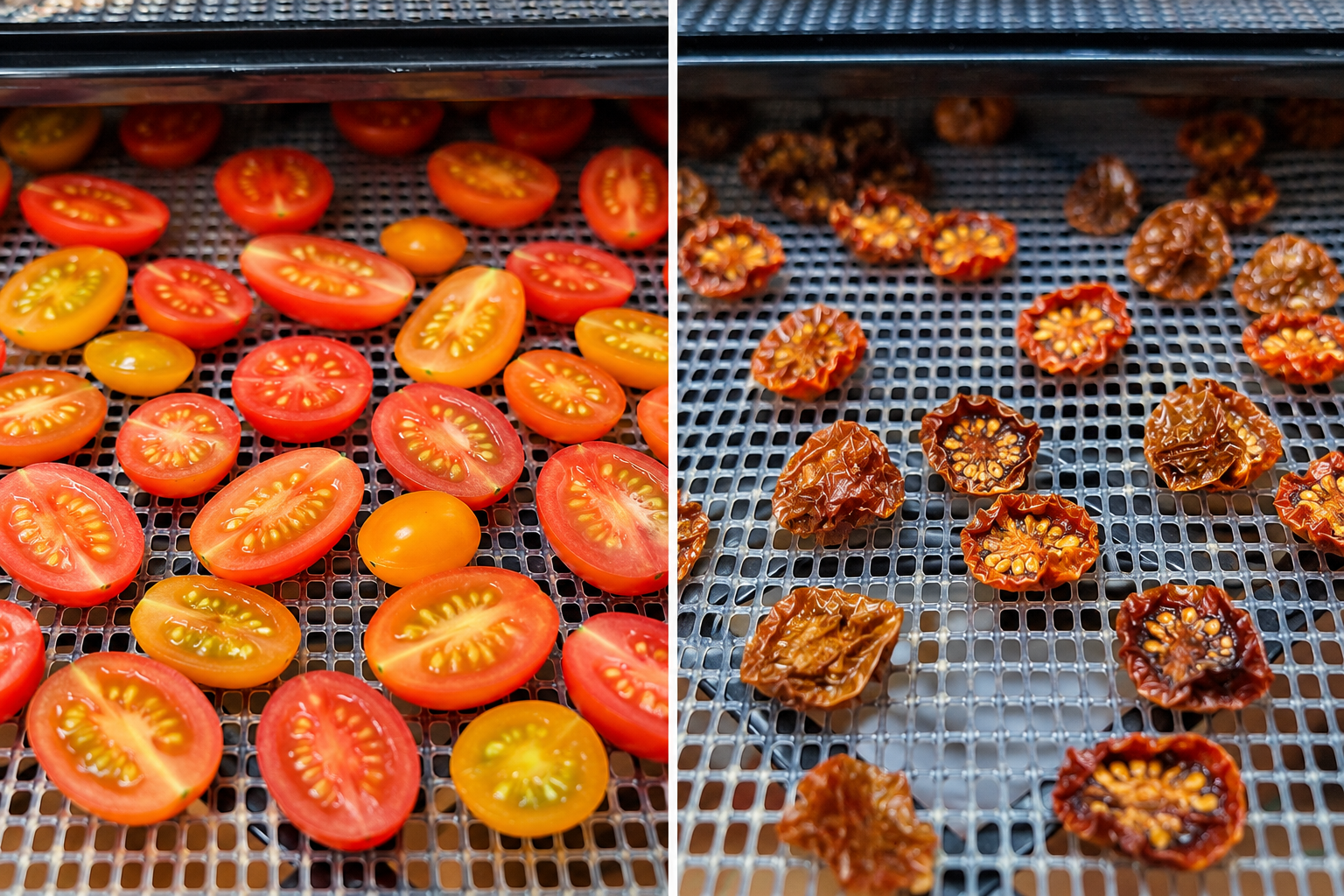
What a difference dehydration makes! Freshly sliced garden tomatoes (left) shrink into small, concentrated pieces (right). For tomato powder, continue drying until the tomatoes are completely brittle after cooling—not soft or flexible.
I set my Excalibur dehydrator to 135°F (57°C) and started with 12 hours.
After checking the tomatoes, I ended up drying them for approximately another 12 hours.
That doesn’t mean every batch will take 24 hours. Drying time varies depending on the tomato variety, the thickness of the slices, humidity, airflow, and the dehydrator itself.
The important thing is how dry the tomatoes are, not how many hours they’ve been in the dehydrator.
For tomato powder, you want the pieces to be completely dry and brittle after they’ve cooled.
They shouldn’t feel flexible, sticky, or gummy like raisins. Any remaining moisture can cause problems when the tomatoes are ground and stored.
Step 3: Cool and Grind
Once the tomatoes are completely dry, let them cool.
Transfer them to a blender or food processor and grind until you reach the texture you prefer.
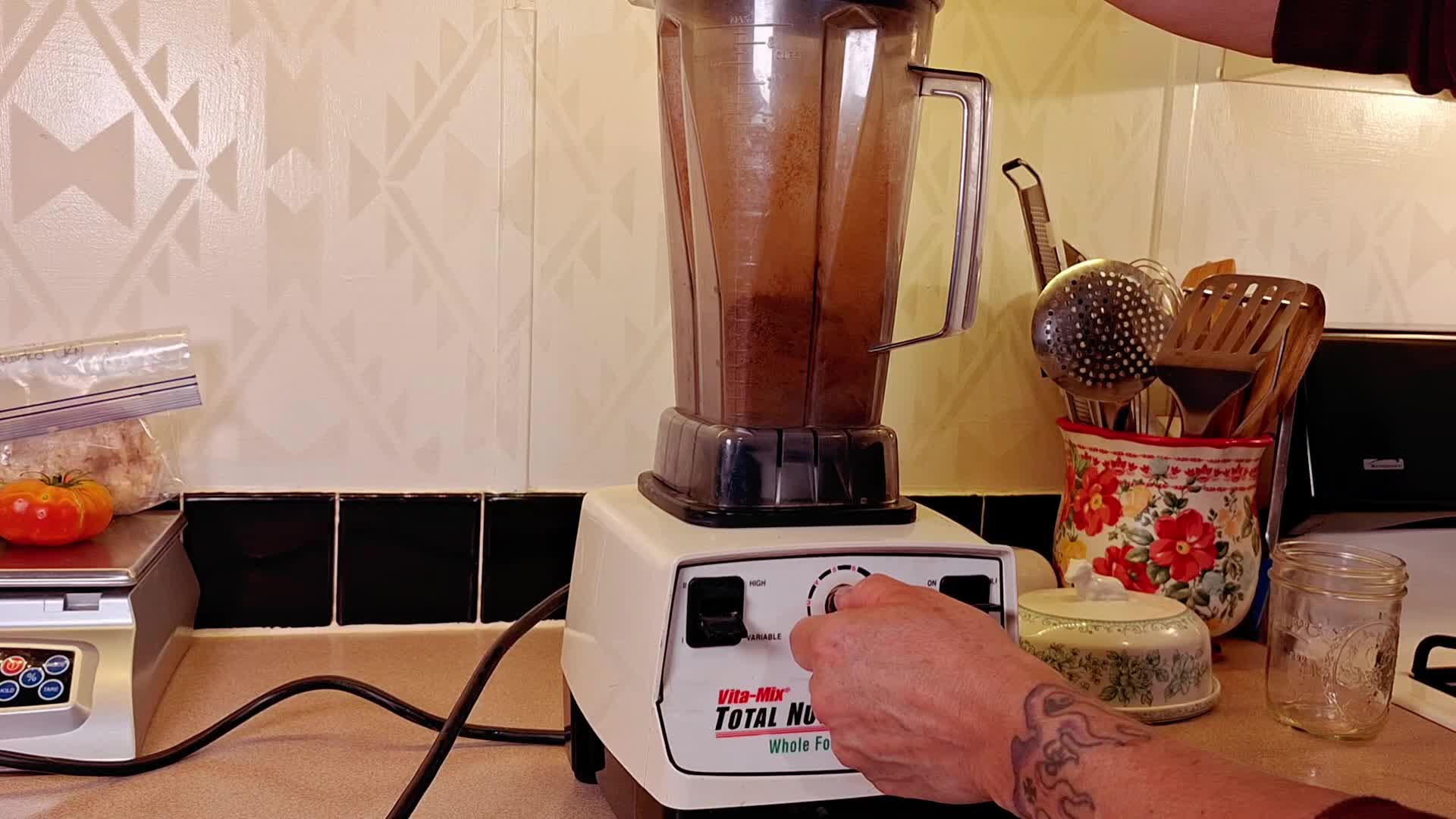
Once the dehydrated tomatoes are completely dry and brittle, a high-powered blender or food processor can turn them into a fine, concentrated tomato powder in seconds.
A powerful blender can produce a fine powder, while other equipment may leave a slightly coarser texture. Either can work for cooking.
Be careful when opening the blender, because finely ground tomato powder can create a little cloud of dust!
Step 4: Store in an Airtight Container
Transfer the finished powder to a clean, completely dry jar with a tight-fitting lid.
Label it with the contents and date, and keep it in a cool, dry, dark location.
For best results, make sure the powder is thoroughly dry before storing it. Watch for moisture, condensation, or clumping, especially during the first several days.
If you notice signs of moisture, don’t simply seal the jar and put it back in the pantry. Moisture can encourage spoilage.
I prefer making manageable batches and keeping an eye on their condition rather than assuming every homemade powder will last indefinitely.
How to Use Tomato Powder
This is where tomato powder really shines.
It’s highly concentrated, so a little goes a long way. You can use it directly in recipes or add water to make something closer to tomato paste or sauce.
Make Tomato Paste from Tomato Powder
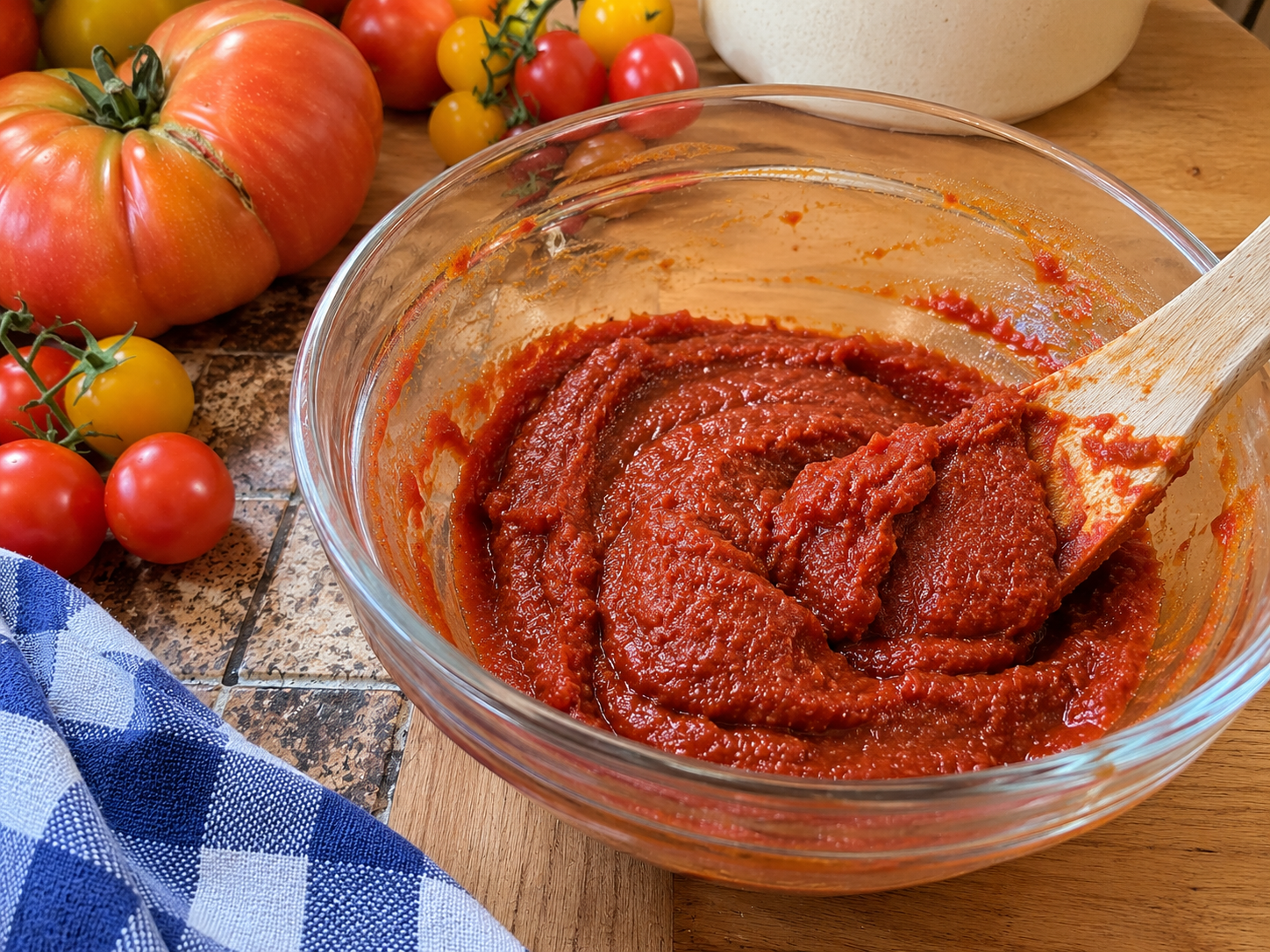
No need to open an entire can of tomato paste when you only need a tablespoon or two! Just mix homemade tomato powder with a little water to make exactly the amount your recipe calls for.
This is one of my favorite uses because I often need only a small amount of tomato paste.
Start with:
- 2 tablespoons tomato powder
- 1 tablespoon water
Mix until smooth. If the mixture is too thick, add a little more water until it reaches the consistency you need.
The exact amount of water will depend on how finely your tomatoes were ground and how thick you like your paste.
Now, instead of opening an entire can for one recipe, I can make exactly the amount I need.
Make Tomato Sauce from Tomato Powder
You can also make a simple tomato sauce substitute by adding more water.
Start with:
- ¼ cup tomato powder
- Approximately 1 cup water
Whisk together, then adjust the water to get the consistency you want.
This works particularly well when the sauce will be incorporated into another recipe. The finished texture and flavor won’t necessarily be identical to a traditionally cooked tomato sauce, but it’s a very convenient substitute.
Other Ways to Use Tomato Powder
You can also add small amounts directly to:
- Soups and stews
- Chili
- Rice dishes
- Pasta sauces
- Enchilada sauce
- Vegetable broth
- Beans and other savory dishes
Start with a little, taste, and add more as needed. Remember, the tomato flavor is concentrated.
Homemade Vegetarian Tomato Bouillon
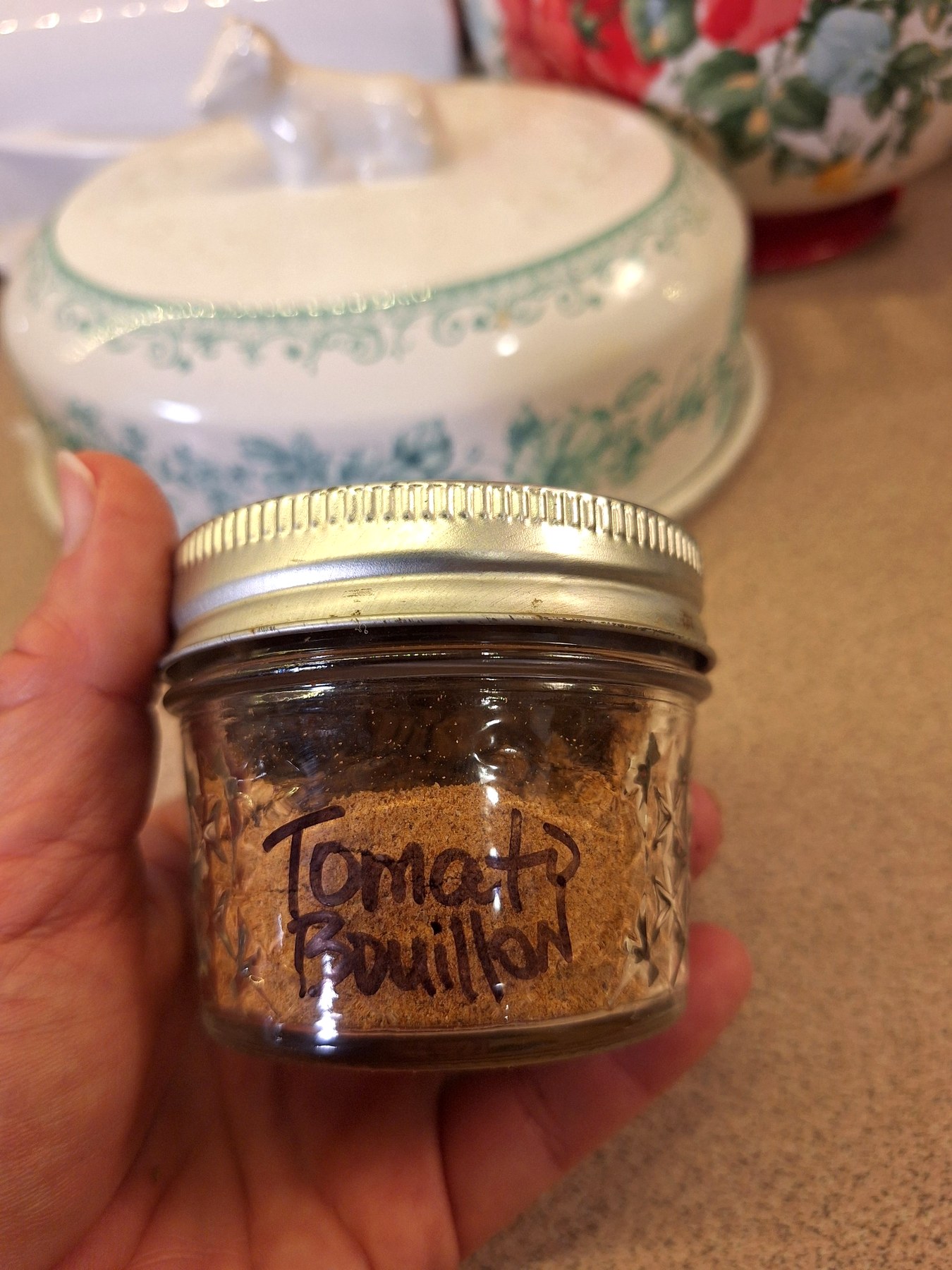
Homemade tomato bouillon made with dehydrated garden tomatoes, herbs, and spices—no chicken ingredients! This flavorful seasoning is perfect for Mexican rice, soups, sauces, and other recipes that need a little extra tomato flavor.
Now for the part I was especially excited about!
I love making Mexican rice, but I’ve had trouble finding a tomato bouillon that doesn’t contain chicken ingredients.
Since I’m vegetarian, that rules out quite a few of the products I’ve found in stores.
Making my own tomato bouillon seemed like the perfect solution, especially since I already had homemade tomato powder.
And the result was even better than I expected.
Homemade Vegetarian Tomato Bouillon Recipe
Ingredients
- 3 tablespoons tomato powder
- 1 teaspoon onion powder
- 1 teaspoon garlic powder
- ½ teaspoon ground cumin
- ½ teaspoon paprika
- ½ teaspoon salt
- ¼ teaspoon dried oregano
- ½ teaspoon nutritional yeast (optional, for additional savory, umami flavor)
Instructions
- Combine all the ingredients in a small bowl.
- Mix thoroughly until the seasonings are evenly distributed.
- Taste a small amount and adjust the seasonings to your preference.
- Transfer the mixture to a clean, dry, airtight jar.
- Label and store in a cool, dry location.
That’s it!
The tomato flavor is surprisingly rich and concentrated. The nutritional yeast adds another layer of savory flavor, but you can leave it out if you don’t have any.
This is a flexible recipe. You can increase the garlic, adjust the cumin, or add a little more salt depending on how you plan to use it.
How Much Tomato Bouillon Should You Use?
Because this is a homemade seasoning blend rather than a standardized commercial bouillon, there isn’t one exact substitution that will work for every recipe.
For a starting point, try 1–2 teaspoons per cup of liquid, then taste and adjust.
You can also add the dry seasoning directly to rice, beans, soups, and sauces.
Keep in mind that this homemade version is less salty than many commercial bouillon products, so you may need to adjust the salt in your finished dish.
Putting My Tomato Powder and Bouillon to the Test
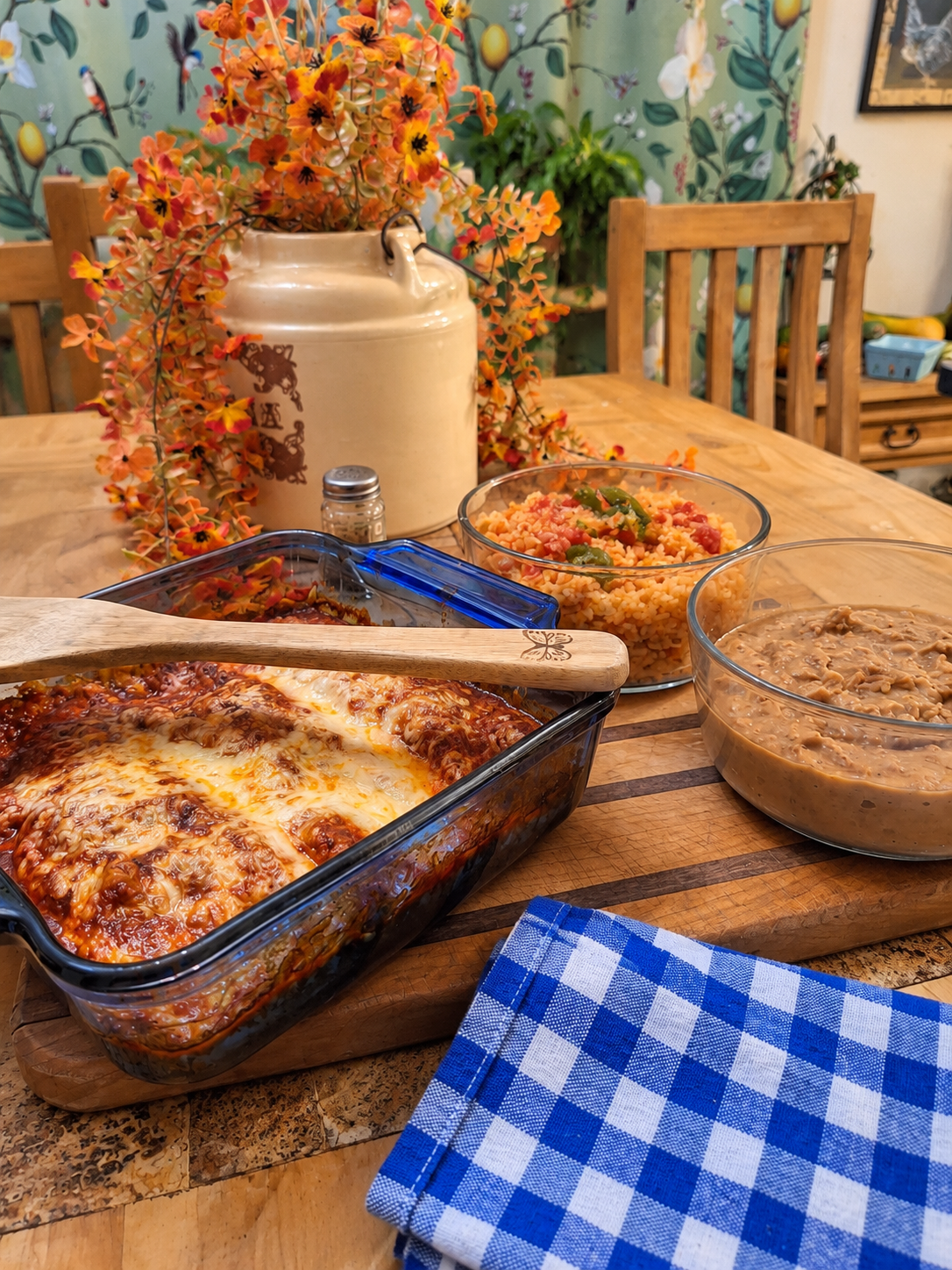
Putting our homemade tomato powder and vegetarian tomato bouillon to work! I used the tomato powder to make enchilada sauce and both the powder and bouillon in my Mexican rice. The result was one of the most flavorful batches of Mexican rice I’ve made!
Of course, making a pantry staple is one thing. Finding out whether it actually improves your cooking is another!
I decided to try both products in recipes I already make.
Mexican Rice
My Mexican rice recipe calls for tomato sauce and tomato bouillon, so it was the perfect opportunity to test the homemade versions.
In the past, I’d substituted a vegetarian chicken-style broth for the tomato bouillon.
The rice was good, but it never had quite the rich color or flavor I was hoping for.
This time, I used my homemade tomato powder and vegetarian tomato bouillon.
It was my favorite batch of Mexican rice in a long time!
The color was richer, and the tomato flavor was much more pronounced. It really took the recipe up a notch.
Homemade Enchilada Sauce
I also used the tomato powder to make homemade enchilada sauce, replacing the tomato paste I would normally use.
That turned out fantastic, too.
These are exactly the kinds of everyday cooking applications that make tomato powder worth having on hand.
Tips for Making and Storing Tomato Powder
A few things are worth keeping in mind if you’re trying this for the first time.
Dry the tomatoes completely. This is the most important step. Tomatoes that are still leathery or flexible aren’t ready to be ground into powder for pantry storage.
Let them cool before testing. Warm pieces can feel different from fully cooled ones.
Keep everything dry. Your blender, utensils, jars, and lids should all be completely dry.
Expect some variation. Different tomato varieties produce different flavors, colors, and textures. That’s part of the fun of using your own garden harvest.
Protect the powder from moisture. Store it tightly sealed, away from heat, light, and humidity. Homemade tomato powder can absorb moisture and clump, so check it periodically and discard it if you notice mold, off odors, or other signs of spoilage.
Make only as much as you can store properly. Drying removes moisture, but it doesn’t make food immune to spoilage. Storage life depends on drying, handling, packaging, and conditions.
Two Useful Pantry Staples from One Garden Harvest
I love finding ways to make better use of what we grow here at Mutiny Ranch.
Turning a pile of fresh tomatoes into a little jar of powder is satisfying enough on its own. But being able to turn that powder into tomato paste, sauce, and a homemade vegetarian bouillon makes it even more useful.
The best part is that both products take up very little space, are easy to use, and let me control exactly what goes into our food.
And after tasting that Mexican rice, I have a feeling I’ll be making quite a bit more tomato bouillon!
If you’ve never tried making tomato powder, I hope you’ll give it a try. You might be surprised by just how useful one little jar can be.
Have you ever preserved tomatoes this way? I’d love to hear how you use tomato powder in your kitchen!


Leave A Reply