
When you have animals, sometimes a problem sneaks up on you slowly.
Other times you walk outside and think, Well, that’s not good.
Our farm pond turning green was definitely the second kind.
By midsummer, large mats of green algae were spreading across the surface of our pond. This isn’t a decorative backyard pond tucked behind some landscaping. It’s part of our animals’ everyday environment. Our pigs, Fletcher and Miti, love the pond. Wildlife uses it. And because of that, my biggest concern wasn’t how ugly it looked.
I wanted to know whether it was safe—and what, if anything, we should do about it.
What followed was several weeks of testing, research, treatment, rain, observation and eventually adding aeration.
Did we discover one miracle product that fixed our pond?
No.
But the pond changed dramatically, and I learned quite a bit in the process.
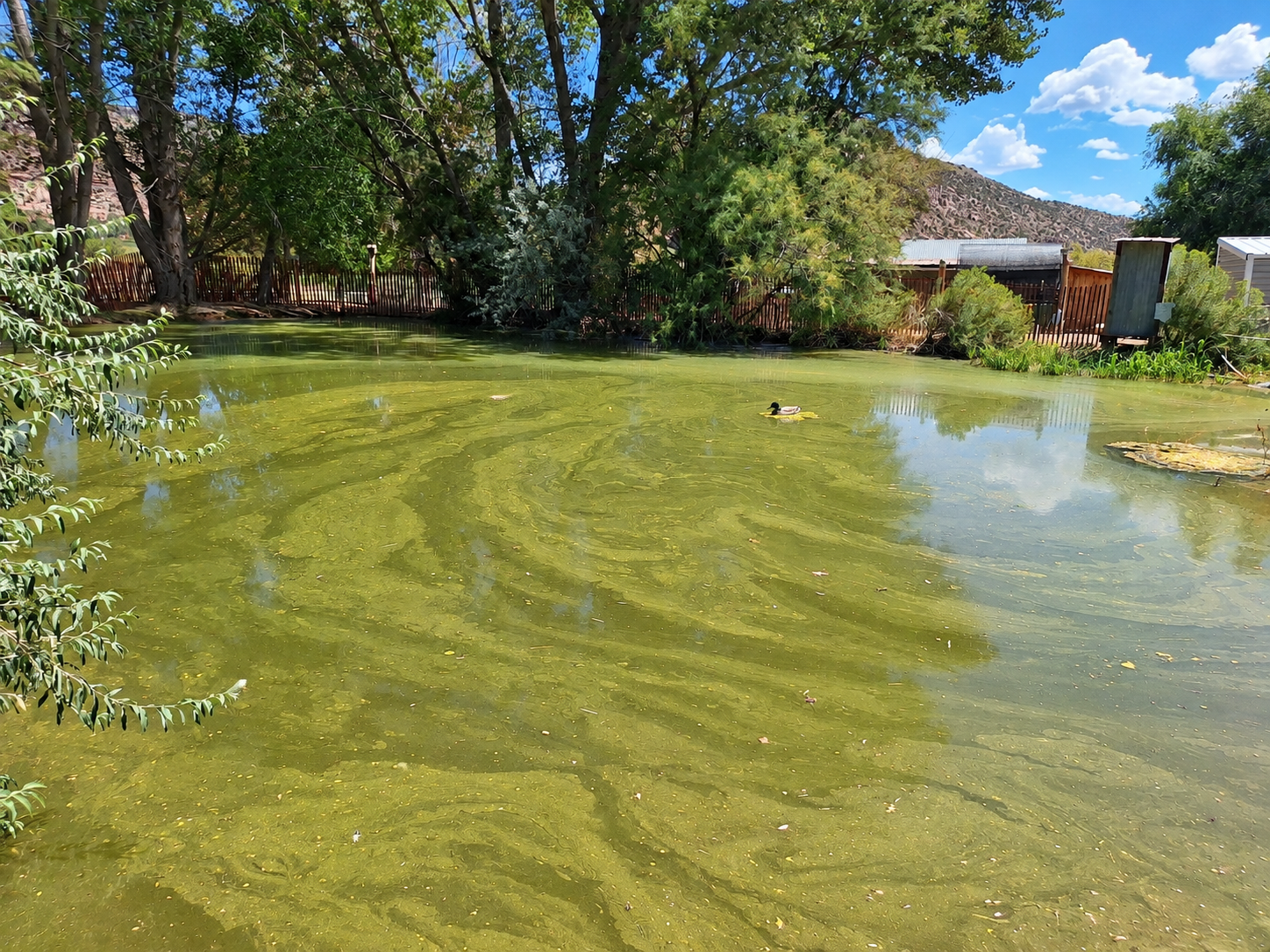
By midsummer, our farm pond was covered in green algae. Because our animals use the pond, my first concern was whether the water was safe.
First, a little about our pond
We live on a small acreage in Southwest Colorado, and this is an old irrigation pond rather than a lined ornamental pond.
It’s roughly 60 feet across and can reach about 8 feet deep when full. Water reaches us through an irrigation system that travels for miles through open ditches before eventually reaching our property.
That means this isn’t a controlled environment. Water, sediment, organic material and nutrients are constantly part of the equation.
Historically, the pond has also fluctuated quite a bit. Some years it has gotten very low or even dried out. More recently, however, it has held water longer.
And our first indication that something might be changing actually happened months before the algae became a problem.
The first warning sign was the smell
During the winter, I began noticing a rotten-egg smell around the pond.
It was bad.
My first stop was our local feed store, where we discussed the possibility that the pond was becoming stagnant and needed better aeration.
Then we discussed the cost of an aeration system.
About $1,200.
Suddenly I became very interested in alternatives.
One thing I decided to experiment with was barley straw. I put a bale into the pond and, eventually, the odor seemed to improve.
Did the barley straw fix the smell?
I have no idea.
That’s an important distinction, because one thing this entire pond experience taught me is how easy it is to change something, see an improvement and assume the first thing caused the second.
Interestingly, barley straw isn’t just some strange pond remedy I stumbled across. It’s actually been studied as a method of reducing algae growth. Research has found that it may help prevent filamentous algae in some ponds, although results are inconsistent and it isn’t considered a treatment for established algae.
So perhaps the barley played a role in what we observed. Perhaps it didn’t.
Either way, eventually the bale broke apart and sank, and life went on.
Until summer.
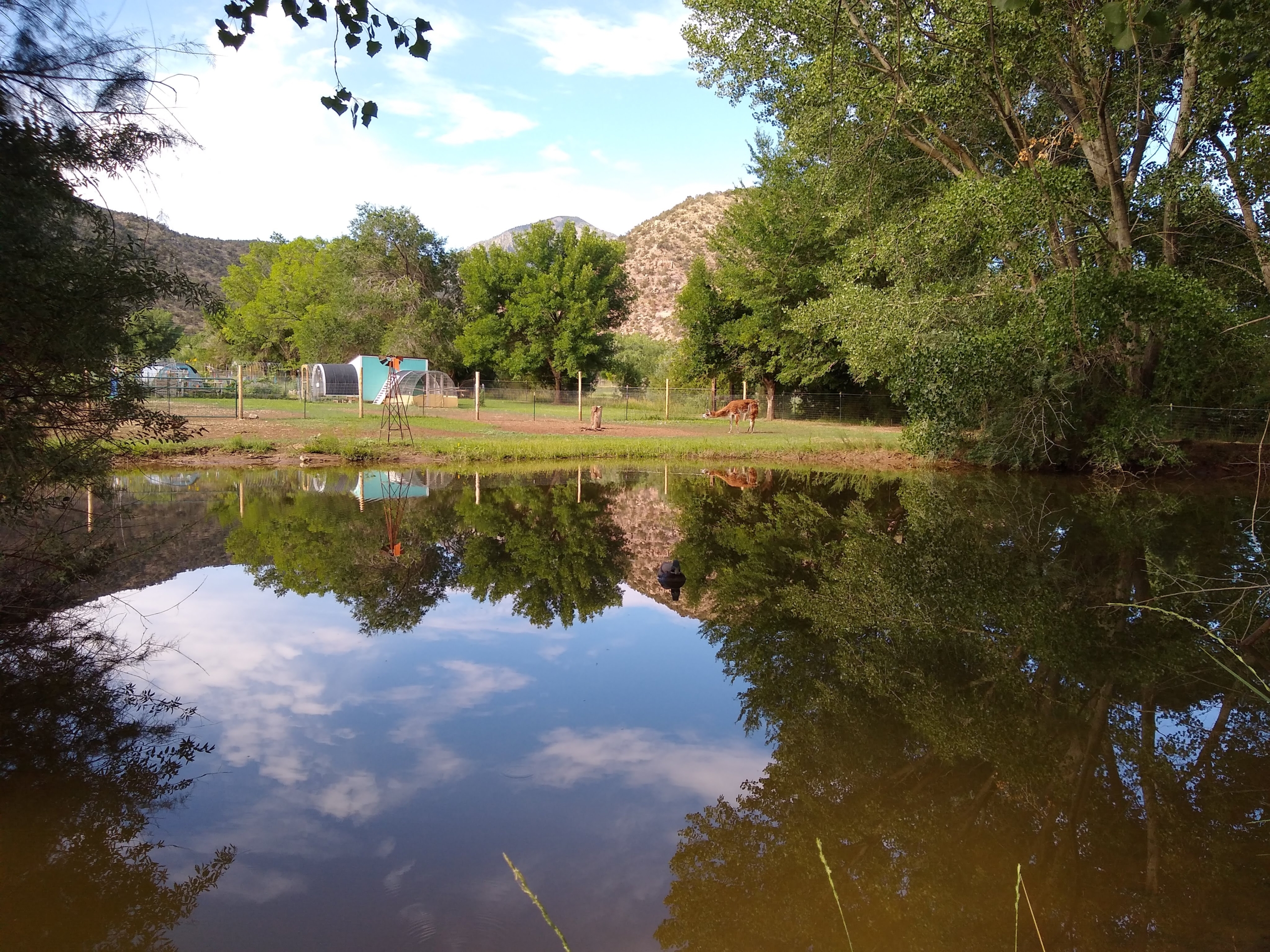
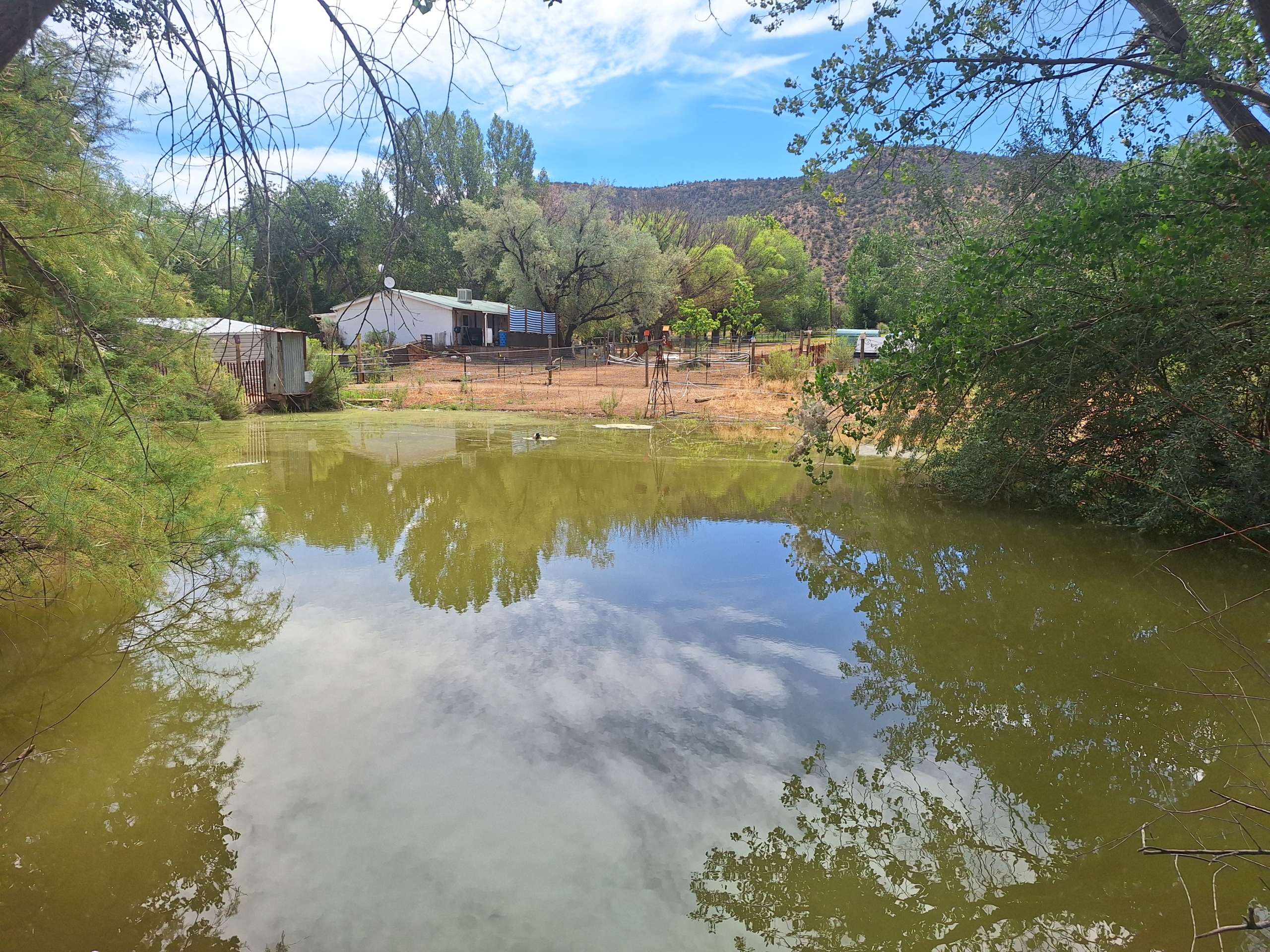
This is what our pond normally looks like—calm, reflective water surrounded by the animals’ pastures.
Then the pond turned green
As temperatures warmed, algae started appearing.
And then it really started appearing.
Large green mats were floating across the pond, particularly around the edges.
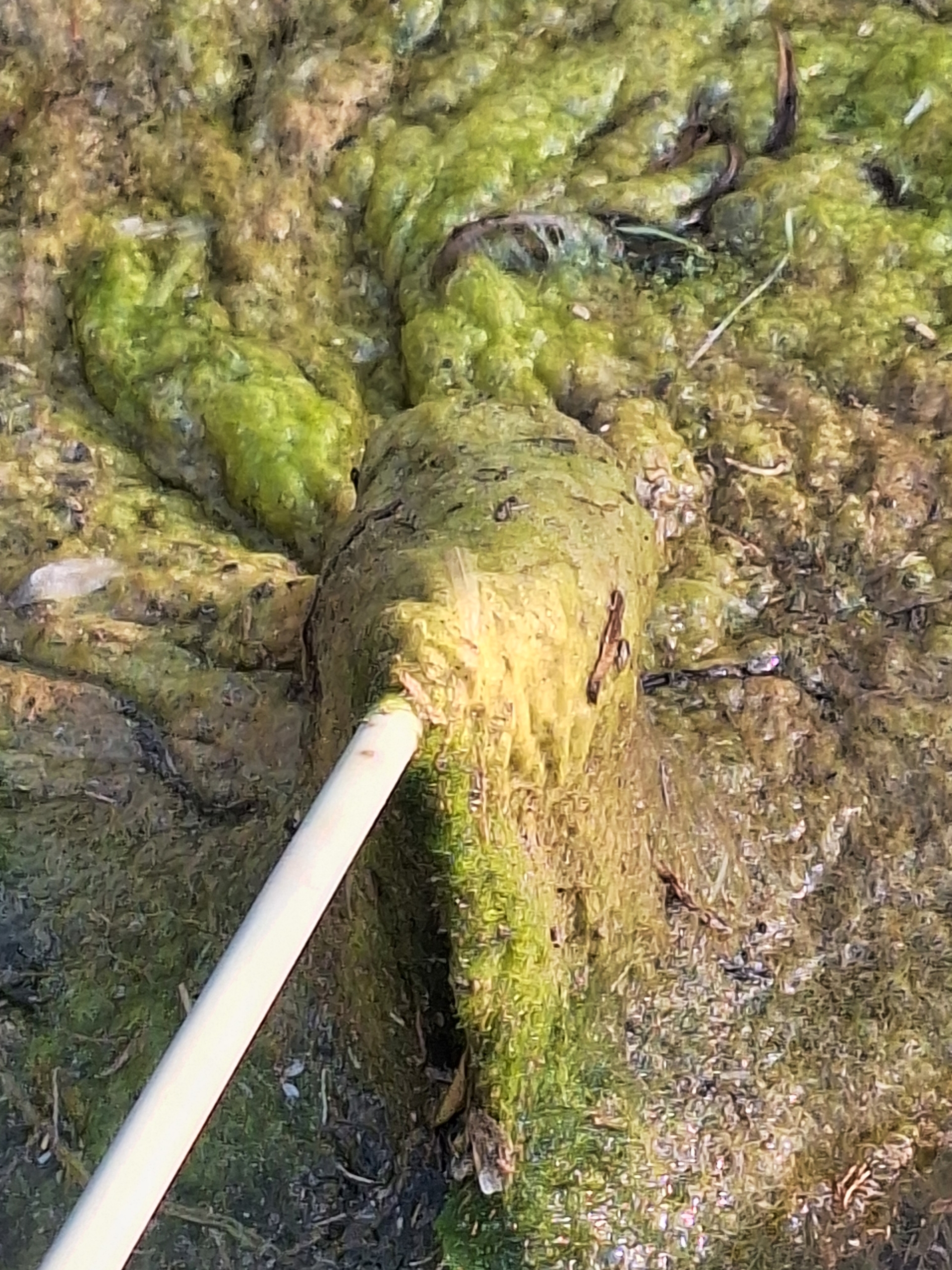
A close-up of the stringy, matted algae we were pulling from the pond. This is the growth that led us to identify what we were seeing as filamentous algae.
Based on its appearance, what we were dealing with looked consistent with filamentous algae. This type of algae grows in long strands that tangle together and can eventually form floating mats that look like wet wool, cotton or slime.
Filamentous algae itself is a normal part of many pond ecosystems. The problem comes when conditions allow it to grow excessively.
Nutrients are a major part of that equation. Runoff, livestock, wildlife, decaying vegetation and other organic material can all contribute nutrients to a pond. Warm temperatures, sunlight and pond conditions can then create a very nice environment for algae.
Unfortunately, our pond has plenty of opportunities for nutrients to enter it.
And the algae wasn’t just unsightly.
Our animals use this pond.
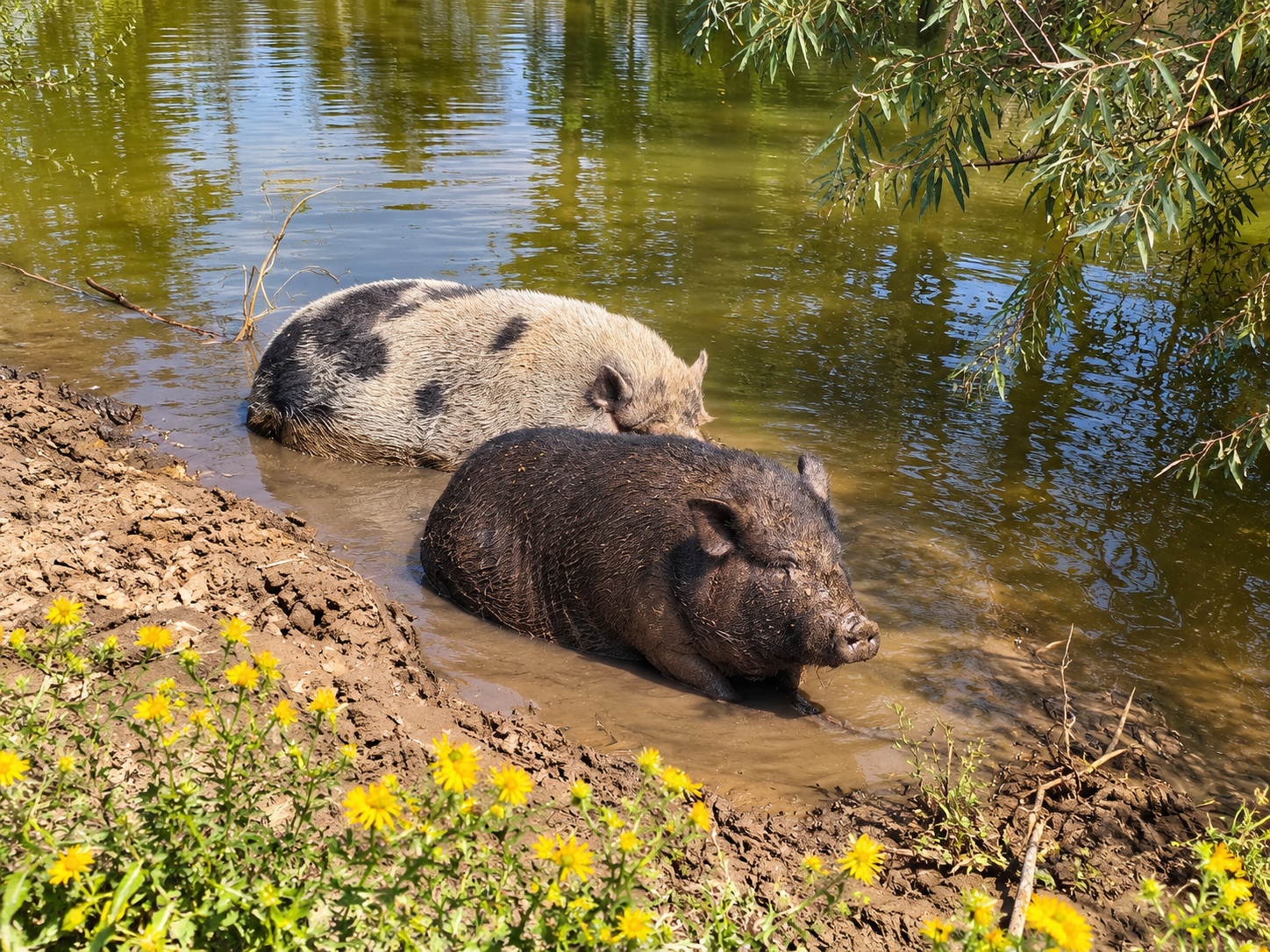
Our rescue pigs, Fletcher and Miti, regularly use the pond to cool off—which is why water safety became my first concern when the algae appeared.
My first concern was whether the pond was safe for the animals
When people see green water or algae, one of the obvious concerns is blue-green algae, or cyanobacteria.
Certain cyanobacteria can produce toxins capable of harming animals and people.
So before I worried about making the pond look better, I wanted more information about what was actually happening in the water.
We temporarily restricted the animals’ access while I investigated.
I purchased a water test designed to detect microcystins, one group of toxins that can be produced by certain cyanobacteria.
Our result was:
No toxin detected.
That was reassuring—but it did not mean I had proven our pond was completely free of every potentially harmful organism or toxin.
It meant that the toxin covered by that particular test wasn’t detected in our sample.
That’s an important limitation.
If you have an unexplained bloom in a pond used by livestock, pets or people, don’t assume green water is harmless based on appearance alone. Testing and professional guidance may be appropriate depending on the situation.
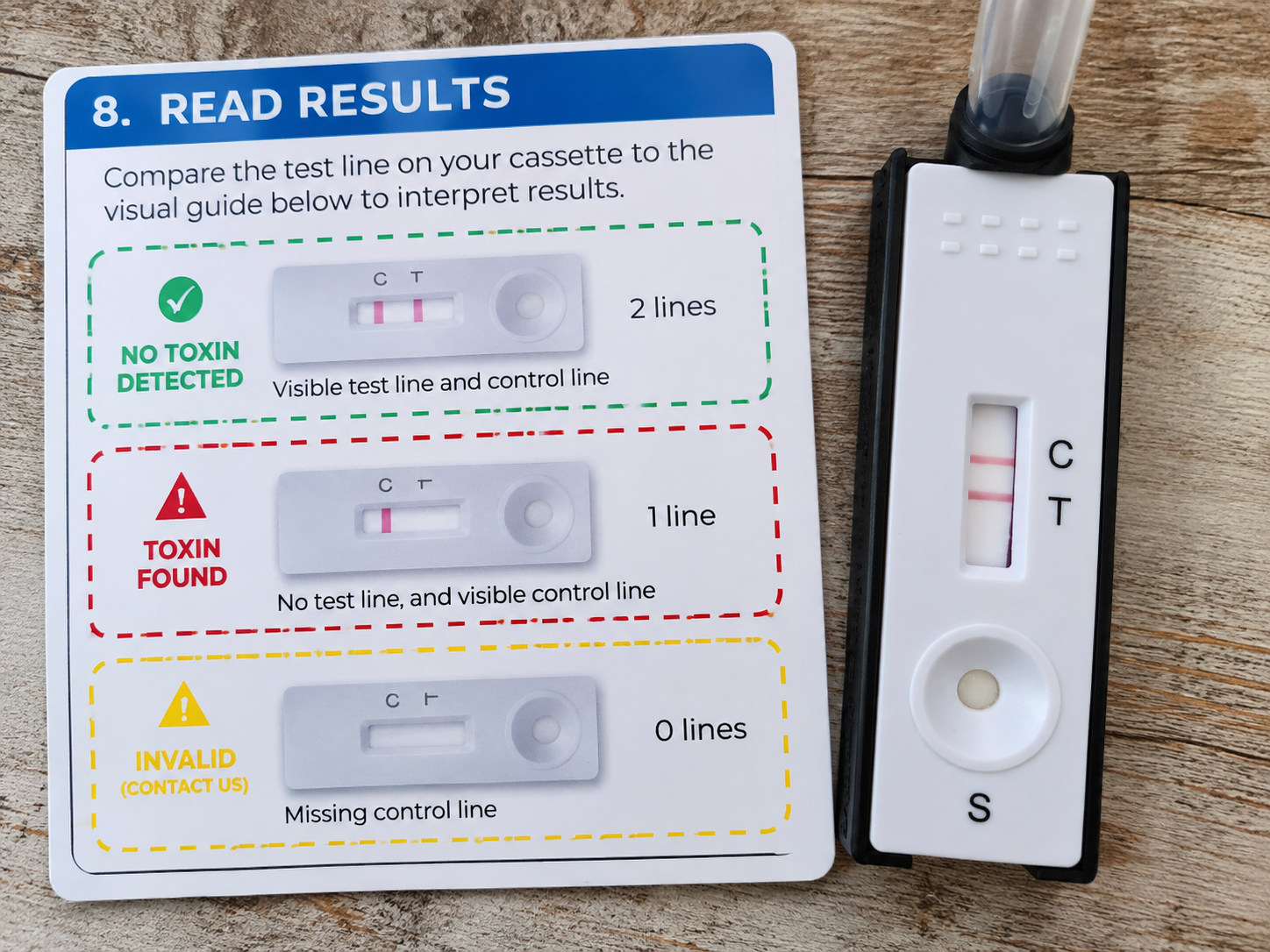
Our water test showed two lines, corresponding to “No Toxin Detected” on the test guide. This test screened for the specific toxin covered by the kit—it did not rule out every possible cyanobacterial toxin or water-quality concern.
So what did we do about all that algae?
Once I felt more comfortable moving forward, I decided to try a pond treatment called Pond Worx.
I wasn’t expecting an overnight transformation. I mainly wanted to see whether improving the pond environment would make a difference over time.
I applied the first treatment on August 18.
Six days later, on August 24, the difference was already noticeable. Large areas of open water had appeared where we’d previously been seeing widespread surface growth.
I took these photos from different sides of the pond, so they aren’t a controlled before-and-after comparison. But they document what we were actually seeing during that week.
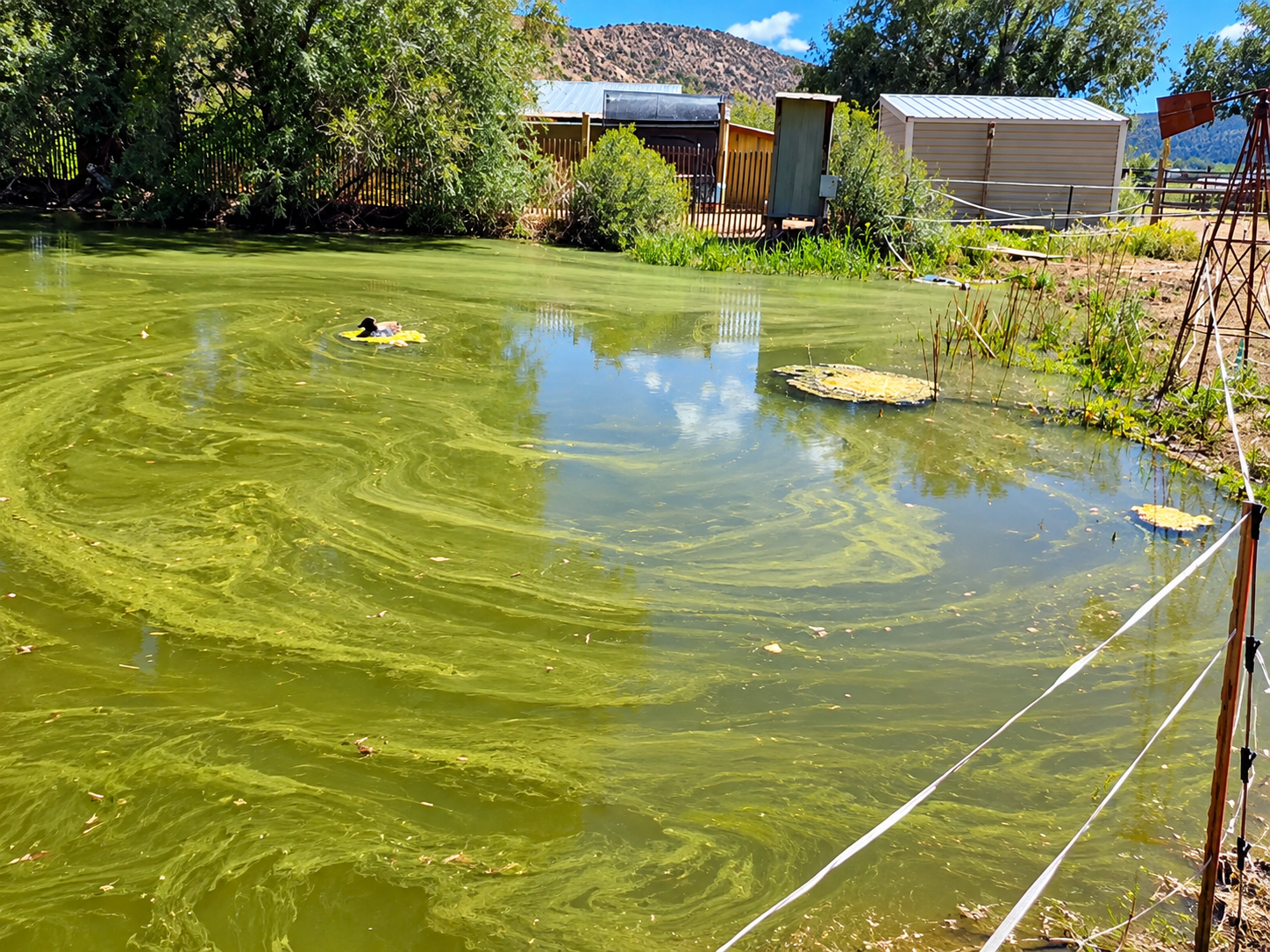
Our pond on August 18, the day of the first Pond Worx treatment. The green algae was still widespread across much of the pond.
August 24—six days after the first Pond Worx treatment. Much more open water was visible, although these photos were taken from different sides of the pond and aren’t a controlled before-and-after comparison.
And then Mother Nature decided to join the experiment.
It rained.
Quite a bit.
Over the next several days, I started seeing a very noticeable change.
The thick mats began disappearing.
Within roughly 10–12 days of starting the treatment, the pond looked dramatically better.
Here’s where I’m going to disappoint anyone looking for a simple product review:
I cannot tell you that Pond Worx single-handedly cleared our pond.
We had several variables changing close together.
I treated the pond.
We received substantial rain.
Temperatures and other environmental conditions were changing.
The pond received additional water and movement.
Any or all of those things could have contributed.
I can tell you what I observed.
I cannot honestly tell you exactly how much credit belongs to each factor.
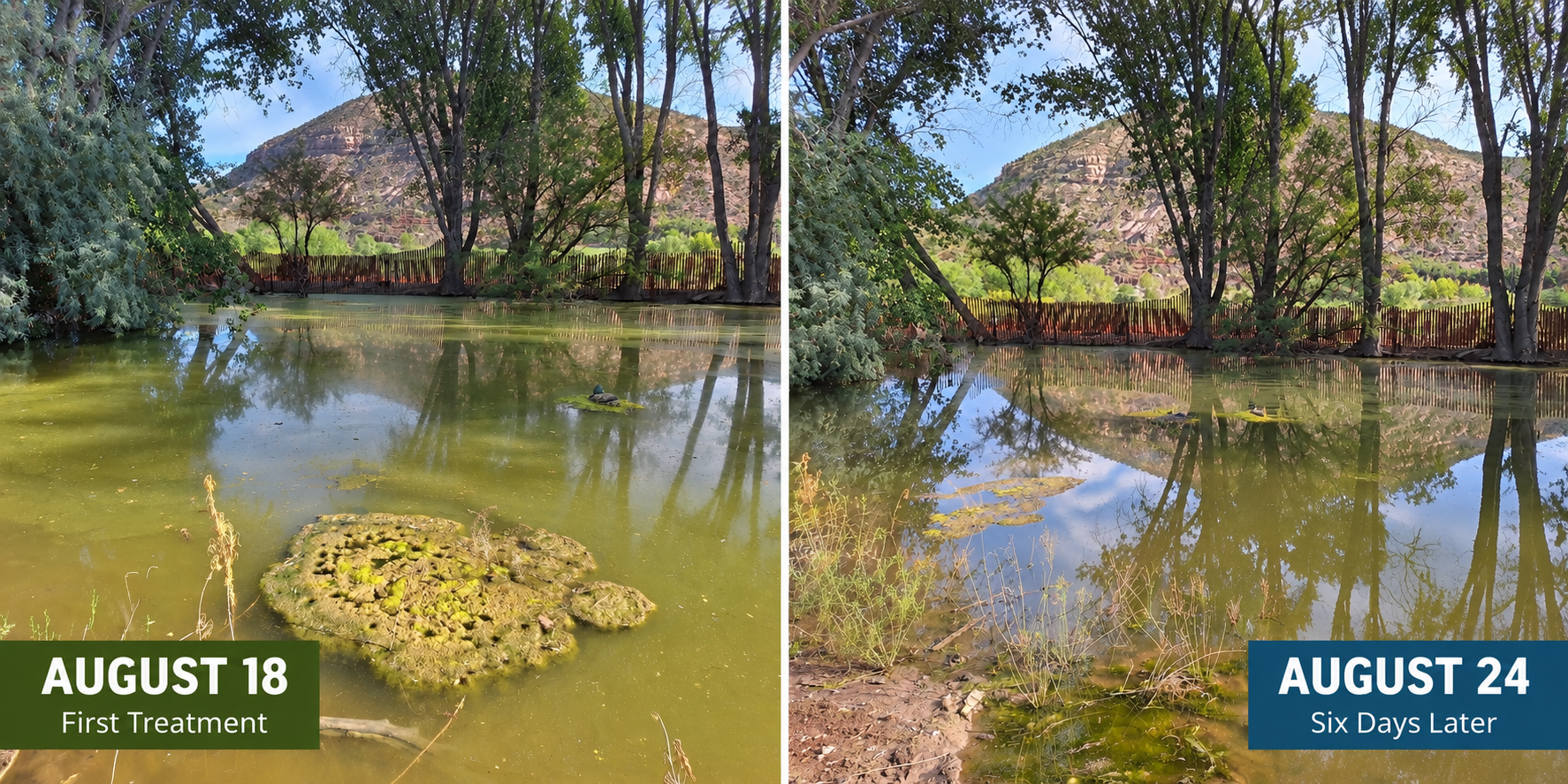
August 18 vs. August 24—six days after our first Pond Worx treatment, noticeably more open water was visible.
Why didn’t we just kill the algae?
One thing I learned while researching pond management is that killing a large amount of algae all at once isn’t necessarily the brilliant solution it sounds like.
When dead algae and other vegetation decompose, that process consumes oxygen.
In a heavily affected pond, a large die-off can potentially contribute to dangerously low dissolved oxygen and even fish kills.
That’s one reason pond-management recommendations often emphasize treating the underlying conditions rather than simply waiting until the pond is covered and trying to kill everything at once.
Physical removal can also be useful because you’re actually removing some of that organic material—and the nutrients it contains—from the pond instead of allowing all of it to decompose back into the water.
This experience changed the way I thought about the problem.
The algae wasn’t really the problem.
It was a symptom telling me something about the pond environment.
We decided to add aeration anyway
Even though the visible algae had already improved substantially, I kept coming back to the same issue we’d first discussed months earlier:
circulation and oxygenation.
Our pond had already given us one warning with the stagnant smell during the winter.
Now we’d experienced excessive algae.
Rather than continuing to react every time the pond did something unpleasant, I wanted to improve the environment itself.
So we finally bought a floating fountain/aerator.
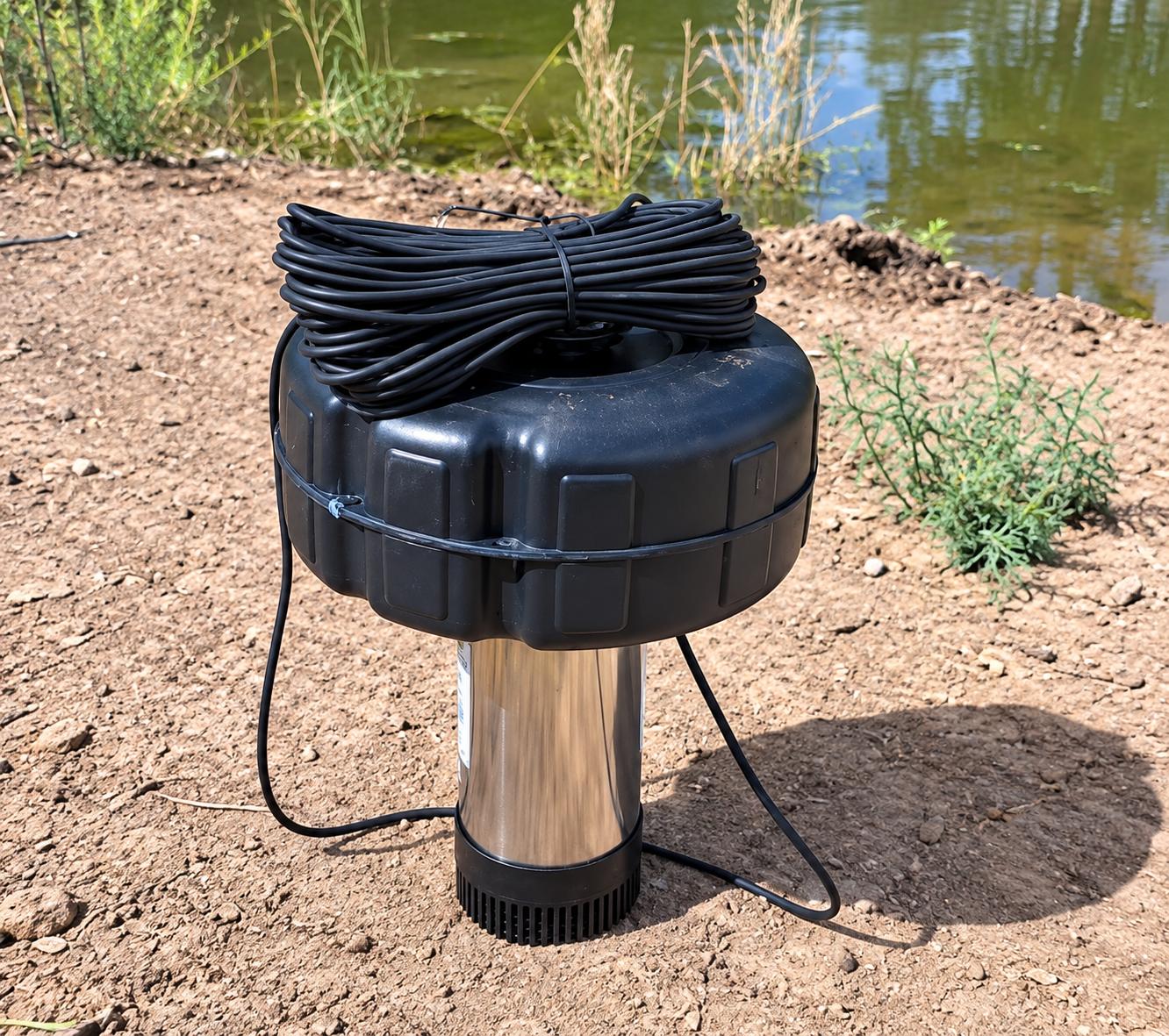
Our 1 HP floating fountain on the pond bank before installation. We chose a surface fountain to add circulation and aeration without the cost and installation involved with the bottom-diffused system we’d originally considered.
The unit we chose is a 1 HP floating fountain that moves roughly 8,000 gallons of water per hour.
We installed it on August 28.
And I want to make the timeline very clear:
The fountain did not clear the algae.
Most of the dramatic improvement we’d observed had already occurred before we installed it.
That’s important because it would be incredibly easy to show a green “before” pond, show a fountain running in the “after” pond and accidentally imply that the fountain caused the transformation.
It didn’t.
What we’re hoping the fountain will do is help maintain better circulation and gas exchange as part of our longer-term pond management.
Research supports good circulation and aeration as useful components of maintaining a healthier pond ecosystem, although aeration alone isn’t considered a reliable cure for established filamentous algae.
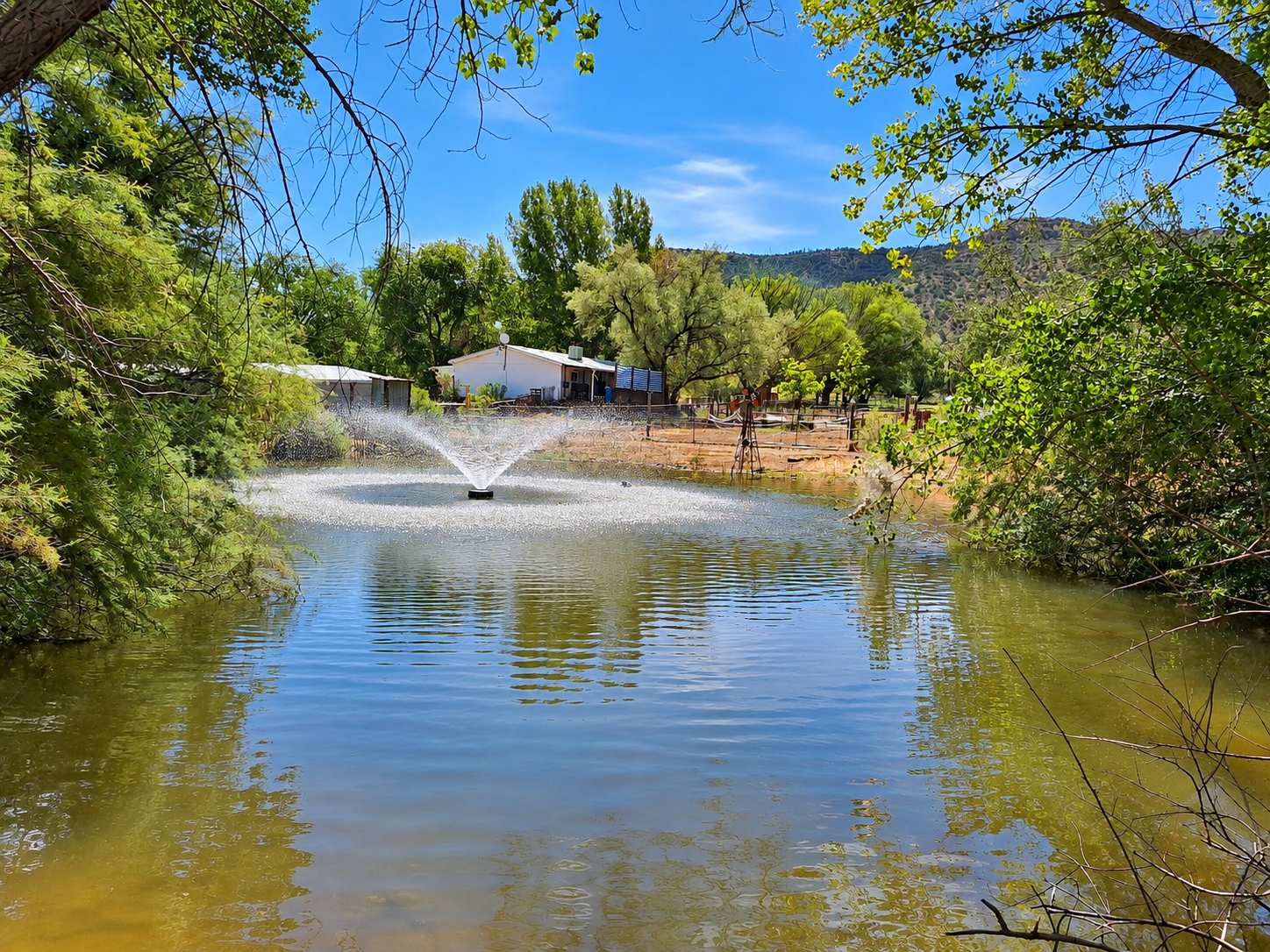
Our floating fountain running in the pond after installation. We added it for ongoing circulation and aeration—not as a quick fix for the algae bloom, which had already improved substantially before the fountain was installed.
A fountain isn’t the same thing as bottom-diffused aeration
This was another thing I learned during the process.
A floating fountain primarily moves and aerates water near the surface.
A bottom-diffused system uses air diffusers placed at depth to move water vertically through the pond.
For a deeper pond with serious stratification or oxygen problems, those distinctions can matter.
Our fountain is not something I’m going to pretend is the ultimate aeration solution for every pond.
It was the solution we chose for our situation after considering cost, pond size, electricity, installation and how we use the pond.
And frankly, we also enjoy it.
The sound and movement are pretty nice.
What actually worked?
This is the question everyone wants answered.
And my answer is:
Probably more than one thing.
Pond Worx may have contributed to the improvement we saw.
Rain and fresh water almost certainly changed pond conditions.
Seasonal and temperature changes may have contributed.
And the fountain is now something we’re using in hopes of creating better conditions going forward.
The pond ecosystem itself is also constantly changing.
That’s why I’m reluctant to declare anything a miracle treatment.
Our pond looked dramatically better after this process.
But the real test isn’t what it looks like for ten days.
It’s what happens next spring and summer.
What I’d do differently next time
If I walked outside tomorrow and found another major algae bloom, I wouldn’t start by buying a shelf full of pond chemicals.
I’d start with:
1. Figure out what I’m actually looking at.
Not everything green in a pond is the same thing.
2. Consider safety first.
Especially when livestock, pets or people have access to the water.
3. Look at what’s feeding the problem.
Runoff, manure, decaying vegetation, stagnant areas, shallow water and nutrient inputs can all matter.
4. Remove what I reasonably can.
Physically removing mats gets that organic material out of the pond rather than letting all of it decompose there.
5. Avoid assuming that correlation proves causation.
If I treat the pond Tuesday and it rains three inches Wednesday, I don’t get to give Tuesday’s treatment all the credit for what happens Friday.
6. Think long term.
I’d rather improve the conditions that encourage a healthier pond than spend every summer fighting whatever grows on top of it.
And I’d start paying attention before the pond looks like something capable of swallowing a small child.
That part seems obvious now.
The products we actually used
These are the products and equipment that were part of our pond experiment.
Microcystin water test
This is the test we used when I was concerned about possible cyanobacterial toxins.
Pond Worx
We made two applications one week apart. I saw substantial improvement during that period, but because rain and other environmental changes occurred at the same time, I can’t attribute the improvement solely to this product.
1 HP floating pond fountain/aerator
We installed this after most of the visible algae had already cleared. We purchased it primarily as a longer-term investment in water movement and aeration rather than as an algae treatment.
[Affiliate disclosure: Some links in this post may be affiliate links. If you purchase through one of these links, I may earn a commission at no additional cost to you. As an Amazon Associate I earn from qualifying purchases.]
Watch the entire pond transformation
I documented this whole process on our YouTube channel, including what the pond looked like at its worst, the treatments, testing, fountain installation and the improvement we saw.
Sometimes the most useful part of owning a small farm isn’t knowing what you’re doing.
It’s documenting what happens while you’re figuring it out.
Our pond isn’t suddenly a perfectly controlled ecosystem, and I’m not suddenly a pond-management expert.
But I understand our pond better than I did before this started.
And next summer, we’ll find out how much we’ve actually learned.


Leave A Reply